Announcements
Meet the ADDF’s 2026 Goodes Prize Recipient: Randy Bateman’s 25-Year Quest to Diagnose, Prevent, and Decode Alzheimer’s
October 27, 2026
Category: Initiatives


When Randall J. Bateman, MD, began studying Alzheimer’s disease over 25 years ago, he was taught that it could not be diagnosed until autopsy. Available treatments eased symptoms without changing the course of the disease. “It was a mostly barren landscape,” he recalls.
Today, a blood test his team developed can help detect Alzheimer’s from a simple blood draw, prevention trials he launched are testing whether dementia can be delayed before symptoms begin, and an AI initiative under his leadership is compressing months of analysis into minutes.
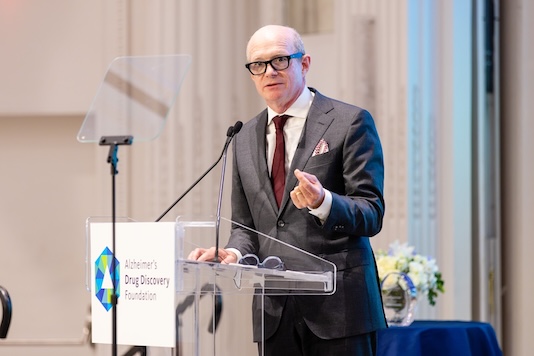
In recognition of that body of work, Bateman, the Charles F. and Joanne Knight Distinguished Professor of Neurology at Washington University School of Medicine in St. Louis, will receive the ADDF’s 2026 Melvin R. Goodes Prize for Excellence in Drug Development, which includes $150,000 to accelerate innovative research. The honor reflects nearly two decades of partnership with the ADDF, which has backed his work from early diagnostics research to AI.
Challenging the consensus
As a neurology resident, Bateman set out to measure how quickly the brain produces and clears amyloid beta, the protein that forms Alzheimer’s plaques. Many scientists believed it could not be done, and his first grant application was rejected on those grounds. When experiments in rats proved inconclusive, he proposed a study with a single participant: himself.
“In medicine, I believe in being willing to do the things that I ask other people to do,” he says.
The experiment worked. It showed for the first time that scientists could track how amyloid beta behaves inside a living person, and that the protein was far more active than anyone expected. Rather than lingering for years, half of it is made and cleared in just over eight hours. That meant the protein left a measurable signature, one that might be detectable outside the brain.
That insight led Bateman’s team toward a tool that could revolutionize Alzheimer’s diagnosis: a blood test. Many experts believed the blood-brain barrier made an accurate test impossible, and two decades of earlier studies had come up empty. Bateman’s team found a clear signal. Before going public, they replicated the finding in two additional studies.
When he presented the results at the 2017 Alzheimer’s Association International Conference, the room fell silent. “I thought, this is it for me,” he recalls. “I’ve done something really wrong.”
He hadn’t. His team has since helped develop blood tests for both amyloid and tau, some reaching 95% accuracy or higher. Bateman co-founded C2N Diagnostics, which, with early support from the ADDF, brought PrecivityAD to clinics as the first Alzheimer’s blood test available to patients. In August 2026, the FDA cleared C2N’s next-generation PrecivityAD2 test for adults as young as 40.
“Today, any doctor can order these tests and get an accurate diagnosis for their patient,” Bateman says. “To see that impact for patients is really quite gratifying.”
Redefining when to intervene
Bateman also founded and directs the Dominantly Inherited Alzheimer Network Trials Unit (DIAN-TU), which runs clinical trials for people with and at risk of dominantly inherited Alzheimer’s disease, a rare genetic form that typically causes symptoms in a person’s 30s to 50s. DIAN-TU has helped map the disease’s earliest biological changes and redefine the timeline for intervention, with findings that could inform prevention for far more common forms of Alzheimer’s.
“We’ve demonstrated that we can delay the onset of dementia in some people by 50%, maybe more,” he says. “Imagine if we could do that for the general population.”
Prevention trials in broader populations are expected to read out over the next one to two years, and Bateman anticipates they will point in the same direction. “What we need to prepare for now is, if these trials are positive, how can we most effectively bring that to the population,” he says, “to prevent people from getting it before it’s too late.”
Putting AI to work
While prevention trials test whether Alzheimer’s can be stopped before symptoms begin, Bateman is equally focused on a more fundamental question: what causes the disease in the first place. He believes AI will be critical to helping us find the answer.
C-BRAIN, a consortium Bateman heads with ADDF investment, brings together philanthropies, patient advocates, pharmaceutical and AI companies, and researchers to accelerate discovery across neurodegenerative diseases. Each partner contributes expertise and data, which Bateman calls “the currency of artificial intelligence.” In one test, a C-BRAIN tool analyzed data from a 122-person study, work that typically takes his team about six months, and independently identified 50 of the team’s 52 findings within minutes.
Planting seeds
Bateman describes the ADDF as “a seed-planting organization.” Its venture philanthropy model backs researchers and technologies early, until they take off and government and other funders follow. He credits the ADDF with “a keen ability to identify what’s really different” and a willingness to support the ideas most likely to move the field forward.
Without that early support, he says, “a lot of those initiatives may never have taken off.”
Two transformations at once
Bateman sees the field on the edge of two breakthroughs: prevention trials that could keep people from developing dementia, and AI that could reveal why Alzheimer’s risk doubles every five years after age 60.
“If we can figure out the causes of Alzheimer’s, and prevent whatever those mechanisms are, we might be able to prevent most Alzheimer’s disease in most people,” he says. “We are at the moment where all of this is going to change.”